
Ever feel stuck? Here's the pattern I keep seeing
Author
Ever feel stuck?
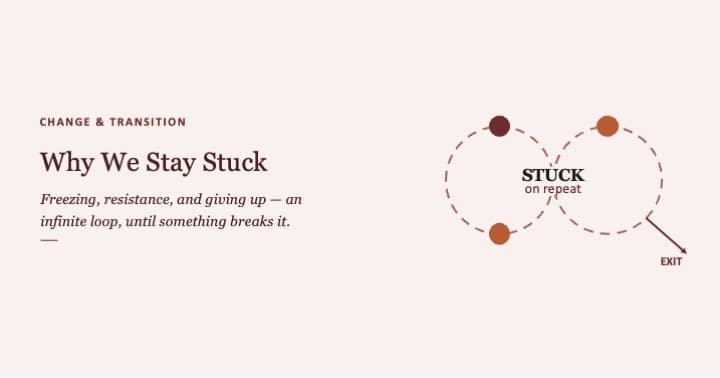
Having coached several clients through transitions, I've noticed a recurring pattern.
Freezing:
When survival anxiety hasn't yet pushed you to take action, and learning anxiety stays high because there isn't enough psychological safety to support creative experimentation, you can end up stuck between these two kinds of anxiety. Mostly experienced as discomfort, fear of the unknown and/or acquiring new skills.
This might feel like uncertainty about whether you can succeed at something new, worry that you'll make mistakes, or concern about how others will perceive you and your learning process. When this anxiety remains high, moving forward feels especially risky.
Imagine standing on a rope bridge between two cliffs: one side is the fear of what will happen if you don't change (survival anxiety), and the other side is the fear of what you might have to go through if you try something new (learning anxiety). Without enough safety to feel secure taking a step, it's easy to get frozen in a place between these two zones(Liminality).
To begin thawing the freeze, it can be helpful to try naming what you feel stuck about, or to reach out to someone you trust and share what is making it hard to move forward. Sometimes, taking even a small step, like pausing for a deep breath or writing down just one fear, can help create "just enough safety" to build a little momentum, feel a bit less overwhelmed, and start to regain a sense of control.
Resistance:
What clients experience as resistance is usually a value protecting itself (a competing commitment). Often, the thing clients want to change lacks a counter-value, which is another core value, need, or belief that could connect or balance the change they are considering. When a counter-value is not recognised, letting go feels like loss rather than growth.
Think of this situation: someone who highly values stability considering taking on a new project at work. Excitement for growth might be pulling them forward, but their value of stability pushes back, making change feel unsettling. If they can recognise how learning this new skill helps them maintain stability in the long run, such as by increasing their job security, they begin to build a bridge between what is important to them now and the growth they want.
Here is another example: someone who values independence is offered a collaborative team-leader role. This individual might resist the offer until they see how teamwork can actually enhance their independence in decision-making and skill-building. Awareness of these counter-values helps make resistance more understandable and workable.
To nail this down, I once worked with a client I'll call Zoe, who was offered an exciting leadership opportunity at work. Although she wanted this chance to grow, she kept hesitating and turning it down. Through our conversations, Zoe realised that her core value of being available and present for her family was making her reluctant to take on the new responsibility, which she feared might require longer hours. At first, letting go of her current routine felt like a loss rather than an opportunity for growth. But once she recognised that developing her leadership skills could actually create more flexibility and stability for her family in the long term, she began to feel more open to the change.
So if you want change that represents growth but you value security, your commitment to security will resist the new direction until you can identify how growth supports or balances that core value. Spotting these counter-values helps move through resistance with more self-awareness.
Giving up:
Mid-experiment, right at the wobble where competence dips hardest, clients give up because they view this stage as proof that whatever they are experimenting with is not working, just one step before the curve turns up.
Wobble is actually an expected part of any growth process and not necessarily a sign of failure. It is mostly a signal that one is learning and stretching their abilities. In fact, almost everyone hits this messy middle, and it is often where lasting change is built.
Most of the time, people either loop back to being stuck or push harder. However, pushing harder hardly solves the problem sustainably. Instead of simply pushing through, it can be more helpful to pause and reflect on what is actually happening or to reach out to someone you trust for support.
Writing down what feels hard might be helpful, especially for decluttering thoughts. Alternatively, set a tiny, specific goal for your next step, like spending just five minutes learning something new. Try a simple reflection exercise, like asking yourself at the end of the day what worked, what felt challenging, and what you might try differently tomorrow. Taking a step back to notice and name your experience, or inviting another perspective, can open up new options for moving forward.
In case you are at this phase, try this reflection:
What makes this stage feel hard now?
What small step or can support make the next step more possible?
Writing or talking through your answers can make the process less overwhelming and more manageable.
Learning:
My learning is that getting unstuck requires psychological safety that lets learning anxiety soften, recognising and acknowledging the phase one is in, and finding the missing balance between strength and counter-value.
A useful first step to support yourself is to reflect at the end of each week and journal about what you notice, how you feel, and thoughts that emerge.
Alternatively, seek support from peers, helping professionals like coaches and mentors, or online communities focused on personal growth, where your experiences are respected.
If you are not ready to reach out to others just yet, you can ask yourself self-coaching questions such as:
What feels hardest about this change for me right now?
What small step could I take to make the next part feel easier?
What would I tell a friend who was in my shoes?
Reflecting in this way can help you uncover new perspectives and create your own sense of psychological safety.
Even professional groups or workshops can provide a space to share and get support.
And if you are wondering how to spot your own counter-values, here is a simple step-by-step process you can try:
What change are you resisting? Identify it and write it down.What is important to me that feels threatened by this change? Name the core value, need, or belief that comes up.How could this change actually support and balance what is important to me??
Look for ways in which a new opportunity might strengthen, protect, and connect to your core value rather than undermine it.Using this approach can help uncover your counter-values, making resistance an ally for wiser choices rather than just an obstacle to change.
If you get stuck, try talking through your answers with a friend, coach, or mentor. Sometimes outside perspective can help reveal connections you might not see on your own.